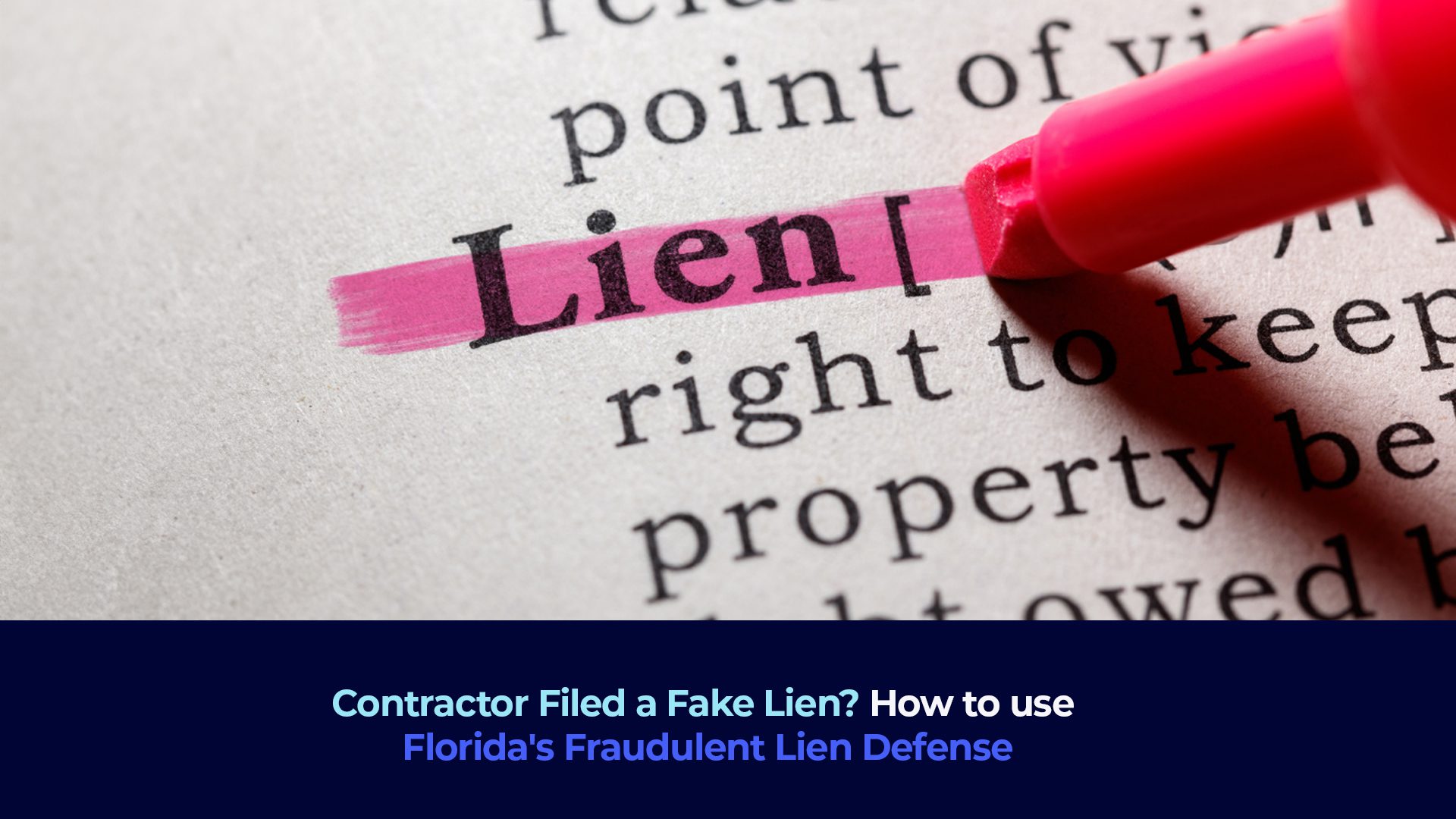
Contractor Filed a Fake Lien? How to use Florida’s Fraudulent Lien Defense
Quick Read Summary (TLDR)
Few things frustrate Florida homeowners more than firing a contractor for poor work, only to discover that same contractor has filed a construction lien for three times the value of the work actually performed. This situation leaves many property owners feeling trapped, unable to sell or refinance their homes while a bogus claim hangs over them. However, Florida homeowners who feel held hostage by fraudulent liens need to know that Florida Statute 713.31 is a “nuclear option” for them, a powerful legal tool that can not only eliminate the lien but also turn the tables on dishonest contractors.
Because defending against a fraudulent lien is a legally complex procedure, homeowners can avoid costly missteps by reaching out to an experienced Florida construction law attorney at South Florida Law. Call us at (954) 900-8885 or use our contact form.
What Makes a Lien Fraudulent Under Florida Law?
Florida Statute Section 713.31 defines a fraudulent lien in three specific ways. First, a lien is fraudulent when the contractor has willfully exaggerated the amount claimed. Second, a lien qualifies as fraudulent when it includes claims for work not actually performed or materials never furnished. Third, a lien becomes fraudulent when compiled with such gross negligence that it amounts to “willful exaggeration”.
It is important to note that Florida courts distinguish between willful exaggeration and honest mistakes. A minor error in a claim of lien or a good faith dispute over the amount owed does not automatically make a lien fraudulent. Courts examine the intent of the contractor when evaluating whether exaggeration was willful. Evidence showing the contractor knew the amount was false, had no basis to know the true amount, or acted with reckless disregard for accuracy can establish the willful intent required under the statute.
Consequences for Filing a Fraudulent Lien
When a court determines that a lien is fraudulent, the consequences for the contractor are severe. The finding of fraud operates as a complete defense to any action to enforce the lien, meaning the court must declare the lien unenforceable. Even more significantly, the contractor forfeits all lien rights on the property—not just the fraudulent portion, but the entire claim.
Beyond losing the lien, contractors who file fraudulent liens face substantial financial liability. Property owners who prevail can recover actual damages, court costs, clerk’s fees, attorney’s fees, and the cost of any bond obtained to clear the lien from the property. Perhaps most notably, the statute authorizes punitive damages equal to the difference between the amount the contractor claimed and the amount actually owed. For a homeowner facing a lien inflated to three times the actual value, this punitive damage provision can result in a significant financial recovery.
Filing a fraudulent lien also constitutes a third-degree felony under Florida law, punishable by criminal penalties. When prosecutors file charges against a contractor for this offense, the Department of Business and Professional Regulation must open an investigation that could result in license suspension or revocation.
“[Florida] statute authorizes punitive damages equal to the difference between the amount the contractor claimed and the amount actually owed.”
Procedural Tools Available to Homeowners
Florida law provides several procedural mechanisms for property owners to challenge suspicious liens. Under Section 713.21, a homeowner can file a lawsuit requiring the contractor to “show cause” within 20 days why the lien should not be vacated and cancelled. If the contractor fails to respond or commence a foreclosure action within this tight deadline, the court will cancel the lien. This approach offers one of the fastest ways to resolve lien disputes, particularly when strong defenses exist.
Property owners can also serve a Notice of Contest of Lien under Section 713.22, which shortens the contractor’s deadline to file a foreclosure lawsuit from one year to just 60 days. If the contractor fails to act within this window, the lien automatically expires.
For homeowners needing to sell or refinance immediately, Section 713.24 allows the transfer of a lien from the property to a cash deposit or surety bond. While this requires posting security equal to the lien amount plus interest and a percentage for potential attorney’s fees, it removes the cloud from the title while litigation proceeds.
Additional Remedies Worth Considering
Homeowners should also consider filing a complaint with the Florida Department of Business and Professional Regulation, which can impose administrative discipline including fines, probation, or license revocation. Additionally, the Florida Homeowners’ Construction Recovery Fund may provide compensation when a licensed contractor cannot pay a judgment.
Given the complexity of Florida’s construction lien laws and the significant financial stakes involved, homeowners facing potentially fraudulent liens should consult with an experienced Florida construction attorney. A knowledgeable lawyer can evaluate whether a lien meets the statutory definition of fraud, file any necessary paperwork, pursue appropriate remedies, and help recover damages from contractors who abuse the lien system.
South Florida Law
Construction lien disputes (and specifically the defense against fraudulent liens) are among the most technical areas of Florida real estate law. The burden of proof to establish “willful exaggeration” under Florida Statute § 713.31 is high, and procedural missteps can be costly. For this reason, homeowners should be wary of “going it alone” or attempting to resolve these high-stakes conflicts without experienced Florida counsel.
At South Florida Law, we provide the personalized attention to detail of a boutique practice combined with the powerful resources of a large firm. We have extensive experience representing homeowners in construction disputes and know how to aggressively challenge invalid liens to protect your property rights. If you are facing an exaggerated lien or a dispute with a contractor, contact us today by calling (954) 900-8885 or reach out via our contact form.