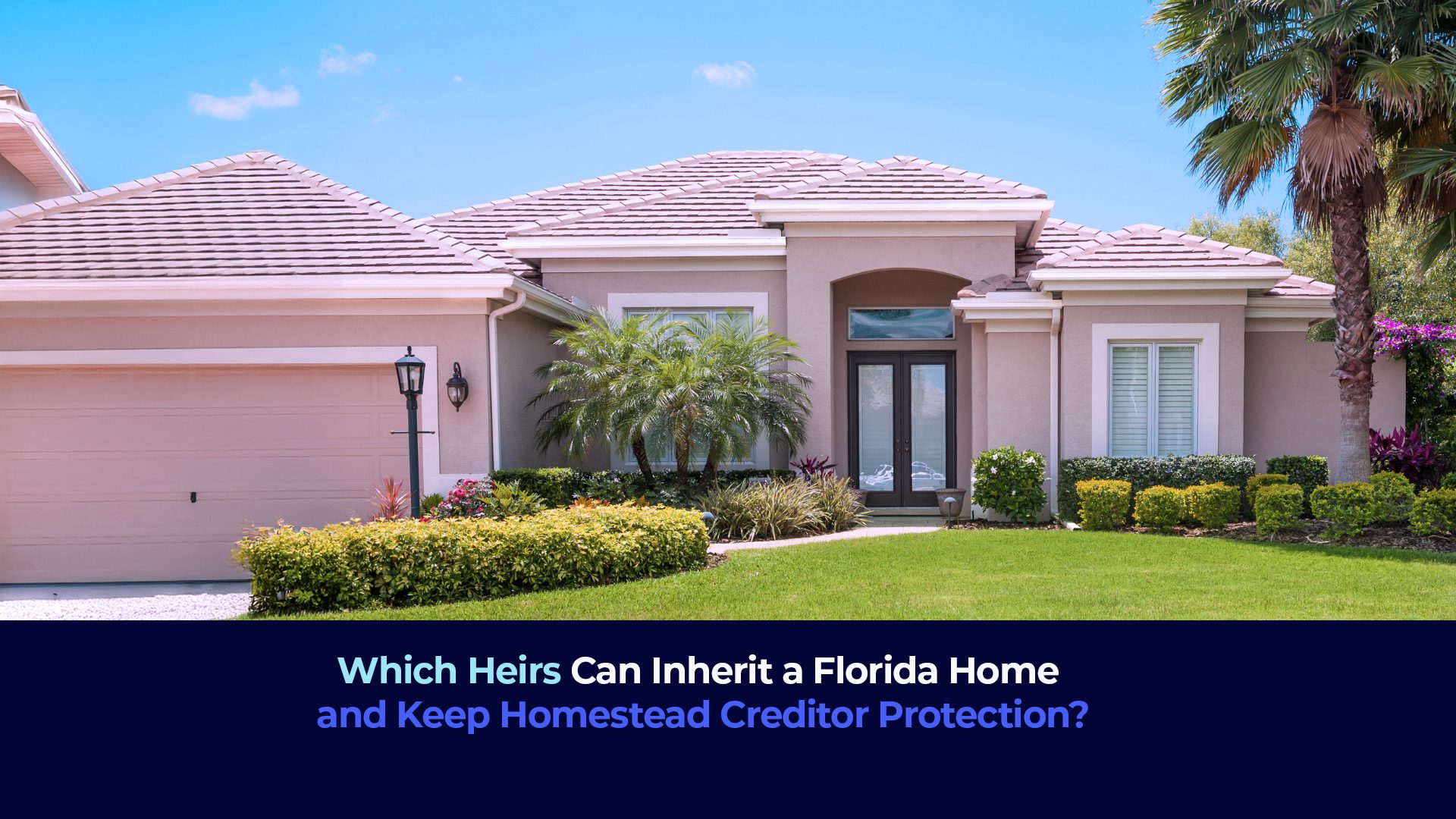
Which Heirs Can Inherit a Florida Home and Keep Homestead Creditor Protection?
Quick Read Summary (TLDR)
Florida’s constitutional homestead creditor protection shields a primary residence from most creditors, a valuable exemption that can continue after the homeowner’s death. Maintaining this creditor shield depends on the property passing to a “qualifying heir,” who is defined by reference to Florida’s intestacy statutes (F.S. 732.103). The landmark Snyder v. Davis Supreme Court decision clarified that the homeowner can bequeath the homestead to any person listed within the statutory class of heirs by will, not just the one who would inherit automatically. Therefore, if a widowed homeowner with no minor children wills the home to any relative (eg: a child, sibling, niece, or cousin) who falls within the broad statutory class of heirs, that beneficiary receives the home with full creditor protection.
Reach out to South Florida Law at (954) 900-8885 or via our contact form.
One of the most powerful legal protections available to Florida homeowners is the constitutional homestead exemption. Under Article X, Section 4 of the Florida Constitution, a person’s primary residence is generally shielded from forced sale by creditors. But a critical question arises when a homeowner passes away: which heirs can receive the home and still keep that valuable homestead creditor protection intact?
The answer lies in the intersection of Florida’s constitutional provisions, its intestacy statutes, and a landmark Florida Supreme Court decision that broadly defined who qualifies as an “heir” for homestead purposes.
Understanding Homestead Creditor Protection
Florida’s homestead creditor protection is rooted in the state constitution rather than ordinary statutes, making it one of the most durable asset protections in the country. The protection covers a primary residence on up to one-half acre within a municipality or up to 160 acres outside one. Importantly, the protection is not capped by dollar value — it applies regardless of how much the home is worth.
However, this protection is not absolute. It does not shield a home from certain obligations, including mortgages, property taxes and assessments, construction liens, and some federal debts. Outside of these exceptions, general judgment creditors — such as credit card companies or medical bill collectors — typically cannot force the sale of a homestead property to satisfy a debt, even after the homeowner’s death.
Who Qualifies as an “Heir” Under Florida Law?
The key to maintaining homestead creditor protection after death depends on whether the property passes to a qualifying heir. Florida Statutes 732.103 defines the classes of heirs under the state’s intestacy laws. These include, in order of priority: descendants of the decedent (children, grandchildren, and so on), the decedent’s parents, brothers and sisters and their descendants, paternal and maternal grandparents, uncles, aunts, and their descendants, and even the kindred of the decedent’s last deceased spouse.
This statutory framework becomes especially important when a homeowner leaves a will that directs the home to a specific family member who may not be the first in line to inherit under intestacy.
“The key to maintaining homestead creditor protection after death depends on whether the property passes to a qualifying heir.”
The Snyder v. Davis Decision: A Broad Interpretation
The Florida Supreme Court addressed this very issue in the landmark case Snyder v. Davis, 699 So. 2d 999 (Fla. 1997). In that case, a grandmother devised her homestead to her granddaughter by will. The estate’s personal representative argued that the granddaughter was not an “heir” for homestead protection purposes because the decedent’s adult son — not the granddaughter — would have inherited under intestacy.
The Court disagreed and held that the term “heirs” in the homestead provision is not limited to the person who would actually inherit under intestacy at the time of death. Instead, a testator with no surviving spouse or minor children may devise homestead property to any member of the class of persons listed in Florida Statutes 732.103, and that person will receive the property with full creditor protection.
The Court emphasized that Florida’s homestead provision is rooted in public policy and is meant to be construed liberally. Requiring a testator to predict which specific family member would inherit under intestacy — a determination that can change as relatives are born or pass away — would create an unreasonable burden and discourage estate planning.
A Practical Example
Consider a widowed Florida homeowner with no minor children who wants to leave the family home to a niece. Under the Snyder ruling, that niece falls within the class of heirs defined by Florida Statutes 732.103 (as a descendant of the decedent’s sibling). Therefore, the niece would inherit the home with its creditor protections intact, even though the decedent’s own children might have been the first to inherit under intestacy.
The Importance of an Attorney
Because Florida’s homestead laws involve constitutional provisions, statutory requirements, and case law that all work together, it is highly recommended that homeowners and their families consult with an experienced Florida estate planning or probate attorney. Devising a homestead to someone outside the qualifying class — such as a friend or a non-family member — could result in the loss of creditor protection entirely. Proper planning helps ensure that one of Florida’s most valuable legal protections survives for the next generation.
South Florida Law
At South Florida Law, we offer an integrated approach to estate planning and probate, combining the personalized attention of a boutique firm with the comprehensive resources typically found at larger practices. Our firm’s estate planning and probate attorneys understand the complexities of Florida’s homestead laws and work closely with clients to ensure that valuable protections are preserved for their families. If your family is faced with a homestead inheritance matter or if you are planning to will your homestead to someone outside of the qualifying classes, contact South Florida Law on (954) 900-8885 or by reaching out via our contact form.