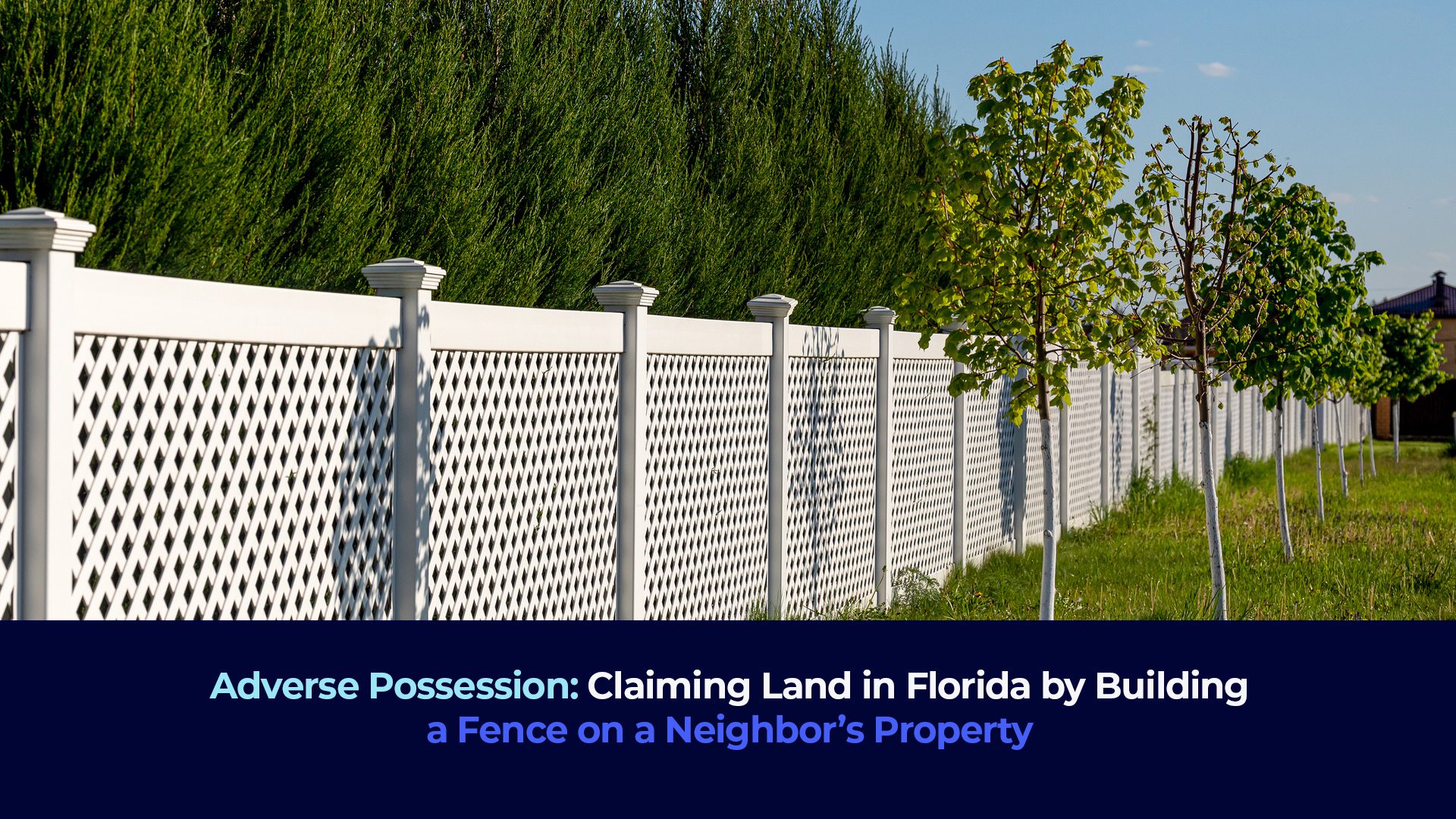
Adverse Possession: Claiming Land in Florida by Building a Fence on a Neighbor’s Property
Quick Read Summary (TLDR)
A neighbor’s fence encroaching on a property line in Florida does not automatically grant them ownership through adverse possession. To successfully claim land without a written title (the typical fence scenario), the neighbor must meet strict requirements, including openly possessing the land for seven consecutive years. Crucially, the person must also pay all property taxes and special liens on the disputed strip of land and formally file a return with the county property appraiser. Most fence encroachment claims fail because the encroaching neighbor rarely fulfills these financial and procedural tax requirements. Property owners discovering an encroachment should immediately get a survey and consult with a real estate attorney to protect their property rights.
Facing this issue or a similar matter? Reach out to South Florida Law for legal advice and representation (954) 900-8885 or via our contact form.
Property owners in Florida sometimes discover that a neighbor’s fence has crossed over the boundary line and sits on their land. When this happens, many people wonder whether the neighbor can legally claim ownership of that strip of property through adverse possession. Understanding how Florida law handles these situations can help property owners protect their rights and know when to take action.
What Is Adverse Possession?
Adverse possession is a legal concept that allows someone who possesses another person’s land to potentially gain ownership of that property. The idea behind this doctrine is that someone who openly uses and maintains land for a long period of time, while the true owner does nothing to stop them, may eventually acquire legal title to that land. However, Florida has made it very difficult to succeed with an adverse possession claim, especially when it involves a fence that encroaches on a neighbor’s property.
The Basic Requirements for Adverse Possession in Florida
For someone to claim land through adverse possession in Florida, their possession must meet specific requirements. Legal experts often use the acronym “OCEAN” to describe these elements: the possession must be Open, Continuous, Exclusive, Adverse, and Notorious for at least seven consecutive years.
Open and notorious means the possession must be visible and obvious, not hidden or secret. A fence certainly meets this requirement since it is clearly visible to anyone who looks at the property. Continuous means the possession cannot be interrupted during the seven-year period. Exclusive means the person claiming adverse possession must use the property to the exclusion of others, including the true owner. Adverse means the possession is without the owner’s permission.
Two Types of Adverse Possession Claims in Florida
Florida law recognizes two distinct types of adverse possession claims, each governed by different statutes and requirements. Understanding the difference between these two types is crucial for anyone involved in a fence dispute.
Adverse Possession Under Color of Title
Florida Statute 95.16 covers adverse possession when the person claiming the land has “color of title.” This means the person possesses some written document, such as a deed, that appears to give them ownership of the property, even if the document contains errors or defects. When someone claims adverse possession under color of title, building a substantial enclosure like a fence can help demonstrate possession. However, there is an important limitation: all the land protected by the fence must be included within the description in the written document. If only part of the fenced area is described in the document, only that portion can be claimed through adverse possession.
Adverse Possession Without Color of Title
Florida Statute 95.18 addresses adverse possession when the person has no written document suggesting ownership. This is the situation that typically applies in fence encroachment cases. While building a fence can satisfy the requirement for “substantial enclosure” under this statute, the person claiming adverse possession faces several additional strict requirements that make success extremely difficult.
The Strict Requirements That Make Most Fence Claims Fail
When someone attempts to claim land through adverse possession without color of title, Florida law imposes demanding procedural requirements. The person must pay all outstanding taxes and special improvement liens on the disputed property within one year of entering into possession. They must also file a formal return with the county property appraiser within 30 days of paying those taxes, providing a complete legal description of the property being claimed. This often requires hiring a surveyor to create an accurate legal description. Additionally, the person must continue paying all property taxes on the disputed land for the entire seven-year period.
Most fence encroachment situations fail to meet these requirements. Property owners typically do not realize that a fence sits slightly over the boundary line, so they do not file the required paperwork with the property appraiser or pay separate taxes on that strip of land. Without completing these steps, an adverse possession claim cannot succeed, no matter how long the fence has been in place.
For example, consider a situation where neighbors built a fence that extended 15 feet onto their neighbor’s property and used that area as part of their backyard for eight years. Even though they met the seven-year time requirement and used the land openly and continuously, their adverse possession claim failed because they never paid property taxes on that 15-foot strip or filed the required return with the property appraiser.
Alternative Legal Theories: Boundary by Agreement and Boundary by Acquiescence
Because adverse possession claims are so difficult to establish in Florida, people involved in fence disputes often raise alternative legal theories. Two common alternatives are boundary by agreement and boundary by acquiescence.
Boundary by agreement requires three elements: uncertainty about where the true boundary line is located, an agreement (either oral or implied) between the neighbors establishing a boundary, and subsequent occupation by both parties in accordance with that agreement for a period of time showing settled recognition of the line as permanent.
Boundary by acquiescence has two main elements: a dispute or uncertainty from which it can be implied that both parties are in doubt about the true boundary line, and continued occupation and acquiescence in a line other than the true boundary for more than seven years. This doctrine can apply when both neighbors have treated a fence line as the boundary for an extended period without objection.
These alternative theories may provide a basis for establishing property rights even when adverse possession requirements cannot be met. However, they require specific circumstances and evidence that may not exist in every fence dispute.
What Property Owners Should Do
Property owners who discover that a neighbor’s fence encroaches on their land should take action promptly. The first step is often to obtain a professional survey to determine the exact location of the boundary line. Having clear, accurate information about property boundaries prevents disputes from arising in the first place.
If an encroachment exists, approaching the neighbor calmly with survey evidence can often resolve the issue without legal action. Many encroachments result from honest mistakes rather than intentional attempts to claim land. A polite conversation may lead to an agreement to move the fence or to formalize the boundary through a property line adjustment.
When informal discussions do not resolve the matter, property owners should consult with an experienced Florida real estate attorney. An attorney can evaluate whether adverse possession or another legal theory might apply, explain the property owner’s rights, and recommend appropriate legal action. Taking prompt action helps protect property rights and prevents situations from becoming more complicated over time.
“Having clear, accurate information about property boundaries prevents disputes from arising in the first place.”
The Importance of an Attorney
Property owners who discover encroachments should address them promptly and beware of attempting to “go it alone.” Consulting with an experienced Florida real estate attorney ensures that property rights are protected, communications are documented, and that disputes are resolved in accordance with state law.
South Florida Law
While discovering that a neighbor has encroached on your property in Florida can be frustrating, it does not automatically mean that you have lost your property. Homeowners need to beware of pitfalls and legal requirements that can impact property ownership in the midst of property claims made by encroaching neighbors. Here at South Florida Law, we have boutique firm attention to detail with the big firm resources necessary to review and draft documents, or take on an encroaching neighbor, and ensure that all efforts are in compliance with Florida Statute, local ordinances, and any relevant HOA regulations.
Are you a landowner facing an encroachment issue? Call South Florida Law for legal guidance at 305.900.8885 or reach out via our contact form.