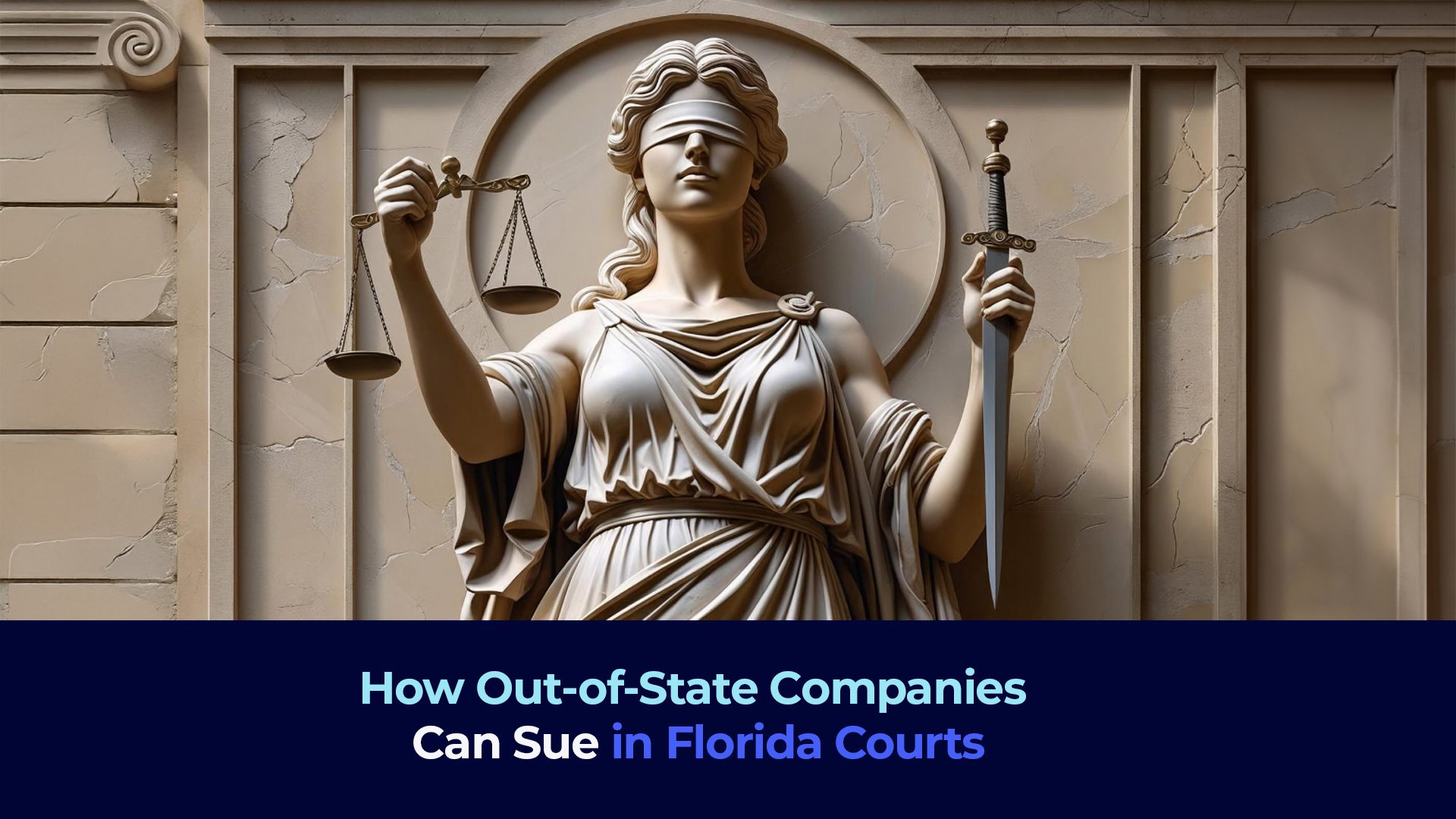
How Out-of-State Companies Can Sue in Florida Courts
Quick Read Summary (TLDR)
To sue in Florida courts, an out-of-state (foreign) corporation or LLC must first register to “transact business” in the state by obtaining a certificate of authority; failure to register triggers Florida’s “door-closing” statute, which prevents the entity from initiating (prosecuting) a lawsuit.
However, an unregistered entity can still defend itself if sued and can cure the non-registration mid-lawsuit by registering and paying all back fees and penalties. Registration is only required if the entity is actually “transacting business,” a term which excludes many passive or isolated activities. Therefore, foreign companies should either proactively register or ensure their Florida activities fall under statutory exemptions to secure their access to the Florida judicial system.
Need representation by an experienced Florida business attorney/ Call South Florida Law on (954) 900-8885 or reach out via our contact form.
A Delaware corporation discovers that a Florida vendor has failed to deliver $500,000 worth of goods as promised. The company’s leadership wants to sue in Florida courts… but there’s a significant problem: the Delaware corporation never registered to do business in Florida. Can it sue in Florida courts, or is litigation in the Sunshine State not an option?
This scenario plays out more often than most business owners realize. Companies frequently engage in transactions across state lines without considering the legal implications of “foreign registration requirements”. When disputes arise, the question of courthouse access becomes important. Florida law provides clear guidance on this issue, though the rules contain nuances that every out-of-state business doing business with entities in the Sunshine State should understand.
Florida’s “Door-Closing” Statute Explained
Florida requires foreign corporations and limited liability companies to obtain a certificate of authority before “transacting business” within the state. This requirement is established under Florida Statutes Section 607.1501 for corporations and Section 605.0902 for LLCs. But what happens when a company fails to obtain that certificate and later needs to pursue litigation?
The answer lies in what legal scholars call Florida’s “door-closing” statute. According to Florida Statutes Section 607.1502, a foreign corporation transacting business in Florida without a certificate of authority “may not prosecute or maintain an action or proceeding” in the state’s courts until it obtains proper authorization. The parallel provision for LLCs appears in Section 605.0904, creating the same restriction for unregistered limited liability companies.
Note that the use of the word “foreign” here refers to any out-of-state corporation or LLC, even if the entity is registered in another US state.
This restriction serves as the state’s enforcement mechanism for registration requirements. Rather than imposing criminal penalties or voiding business contracts, the state simply denies noncompliant foreign entities seeking to bring lawsuits access to sue in Florida courts.
Initiating vs. Defending Lawsuits
One of the most important aspects of Florida’s door-closing statute involves what it does not restrict. While an unregistered foreign entity cannot initiate a lawsuit, Florida Statutes Section 607.1502(5) explicitly preserves the right to defend against legal actions. This means a company that gets sued in Florida can still appear in court, raise defenses, and protect its interests—even without a certificate of authority.
Consider a practical example: A Georgia-based construction company performs work on a Florida project without registering in the state. If the property owner sues the construction company for allegedly defective work, that company can fully defend itself in Florida courts. However, if the construction company wants to countersue for unpaid invoices, it faces the door-closing restriction until it obtains proper registration.
The statute also confirms that failing to register does not invalidate contracts, deeds, mortgages, or other corporate acts. Business agreements remain enforceable, and the foreign entity’s limited liability protection stays intact. The restriction applies specifically to the procedural ability to file and prosecute civil lawsuits in the Florida court system.
Pathways to Courthouse Access
Foreign companies that discover they need to sue in Florida have several potential pathways to proceed. Understanding these options can mean the difference between pursuing a valid claim and watching a statute of limitations expire while navigating bureaucratic requirements. An experienced Florida business litigation attorney can help evaluate which approach makes the most sense for a particular situation.
“Foreign companies that discover they need to sue in Florida have several potential pathways to proceed.”
Obtaining Registration Before Trial
The door-closing statute requires registration before a foreign entity can “maintain” a proceeding, not necessarily before filing one. Florida courts have the authority to stay proceedings while a corporation obtains its certificate of authority. This creates a practical pathway: file the lawsuit to preserve the claim, then complete registration before the case proceeds to trial.
The registration process involves submitting an application to the Florida Department of State’s Division of Corporations. Foreign corporations must file using the “Profit Qualification” form, while LLCs use the “Qualification of Foreign LLC” application. Both require a certificate of existence or good standing from the company’s home state, designation of a Florida registered agent, and payment of applicable fees.
However, retroactive registration comes with financial consequences. Under Florida Statutes Section 607.1502(4), a company that transacted business without authority becomes liable for all fees and penalties that would have been imposed had it registered on time. Courts may also impose civil penalties ranging from $500 to $1,000 for each year of noncompliance.
Demonstrating Registration Was Never Required
Not every business activity in Florida triggers registration requirements. Both Chapter 607 and Chapter 605 contain extensive lists of activities that do not constitute “transacting business” under the statute. A company that limited its Florida activities to exempt categories may argue it never needed registration in the first place—and therefore the door-closing statute does not apply.
Exempt activities under Florida Statutes Section 607.1501(2) include maintaining bank accounts in Florida financial institutions, owning real or personal property without conducting active business operations, soliciting orders that require acceptance outside Florida before becoming binding contracts, and conducting isolated transactions completed within 30 days that are not part of repeated similar transactions.
For example, a California technology company that owns a vacant lot in Florida as a passive investment, maintains a Florida bank account for convenience, and occasionally sends sales representatives to trade shows would likely fall within these exemptions. Such a company could argue it has not engaged in “transacting business” as defined by statute and therefore retains courthouse access without registration.
The statute explicitly notes that its list of exemptions is not exhaustive, meaning other activities may also fall outside registration requirements. This determination often requires careful legal analysis of the specific facts involved. Companies facing this question should consult with a knowledgeable Florida attorney before making assumptions about their registration obligations.
Special Considerations for LLCs
The Florida Revised Limited Liability Company Act, codified in Chapter 605, contains provisions largely mirroring those applicable to corporations. Section 605.0904 establishes the same courthouse access restriction for unregistered foreign LLCs, while Section 605.0905 lists substantially similar exempt activities.
One notable distinction involves income-producing property. Section 605.0905(3) specifically states that owning income-producing real property or tangible personal property in Florida constitutes transacting business for registration purposes. A foreign LLC that owns rental property in Florida would therefore need to register, unlike one holding property purely as a passive investment without generating income.
Planning Ahead Prevents Challenges
The best approach to Florida’s registration requirements involves proactive compliance rather than reactive problem-solving. Companies anticipating litigation in Florida should evaluate their registration status early in the process. Those already operating in Florida without registration should consider formalizing their status before disputes arise.
Business owners facing questions about registration requirements, courthouse access, or pending litigation involving foreign entities should seek guidance from a qualified Florida business attorney. The interplay between registration rules and litigation rights involves subtle distinctions that can significantly impact a company’s ability to protect its legal interests in Florida.
South Florida Law
Litigating in Florida’s courts as a foreign (non-Florida registered) entity requires planning, strategy, and knowledge of the strategic options available. If you are considering an impending legal action against a Florida company, beware of “going it alone.”
The experienced Florida business attorneys of South Florida Law regularly represent non-Florida clients. We provide the best of both worlds when it comes to legal representation: South Florida Law provides the attention to detail and partner-level involvement of a boutique law firm with resources comparable to those of large law firms.
Contact us at (954) 900-8885 or via our contact form.