
Agreements At a Distance
Signing contracts at a “social distance” has been legally possible since the year 2000 when President Bill Clinton signed the Electronic Signatures Act. From then on, the Federal government has recognized electronic signatures as equally valid counterparts to physical ink-on-paper. There are, however, specific exceptions and conditions.
Consent
The consumer – or party receiving the documentation to be signed, must agree to the use of electronic signatures and be given an ink-on-paper alternative. Only when this consent has been given can an electronically signed document be considered to be valid.
The generally accepted legal requirement is that the consumer or receiving party must scroll past disclaimers, terms and conditions and tick a button to show consent.
Execution
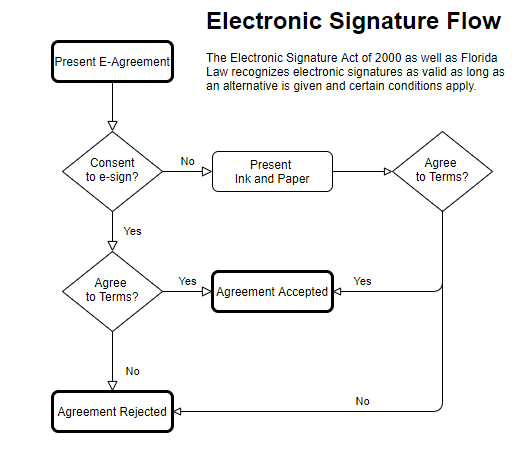
Once consent to use an electronic signature is been given, the consumer or receiving party can execute (or electronically sign) the document. Whereas the consent gives the parties the ability to use electronic signatures to make an agreement, the agreement goes into effect only once the document has been executed. As stated earlier, the consumer or receiving party may opt not to consent to electronic signatures. In this case, the company or sending party must arrange for an ink-and-paper alternative. The figure above shows the electronic signature process.
“The consumer or receiving party may opt not to consent to electronic signatures.”
Electronic Archiving and Retrieval
The consumer or receiving party that consents to electronically sign an agreement must also be given a description of how to access the electronically signed document after it is executed. A common best practice is to store the document in a secure environment (password protected, with AES 256-bit encryption) and deliver the documents via a secure transfer protocol (SSL 186-bit encryption). Secure storage and transfer are required by additional statutes (eg: HIPAA for health-related data) if the content includes certain sensitive and personally identifiable data.
Exceptions
For the time being, at least one exception to the Electronic Signatures Act does exist. Contracts executed in the presence of a witness and/or notary, using a protocol that the legal industry refers to as “wedding signatures” or “we signatures”, are for the most part still required to be done in person. These agreements include house closings and certain legal decrees.
There is some evidence that this may be changing. In the current social distancing environment, certain notary services have emerged that allow for remote witnessing and notary services via video chat programs. It is likely that these services, which are recognized by the courts has valid, will expand in the future. For the time being, it is essential that the use of these services are carefully managed by an experienced attorney in the specific practice area. For example, for a residential or commercial property closing, retain an experienced real estate attorney to oversee the proceedings.
Summary
Electronic signatures have gone from being a modern convenience to a business necessity in these times of social distancing. However, it is important to note that their use is closely governed by existing federal and state laws. If you intend to use electronic signatures to execute binding real estate or business agreements in Florida consult with the experienced business and real estate attorneys at South Florida Law, PLLC to determine if you are in compliance with the law and best practice. We can be reached at (954) 900-8885 or via our contact form.