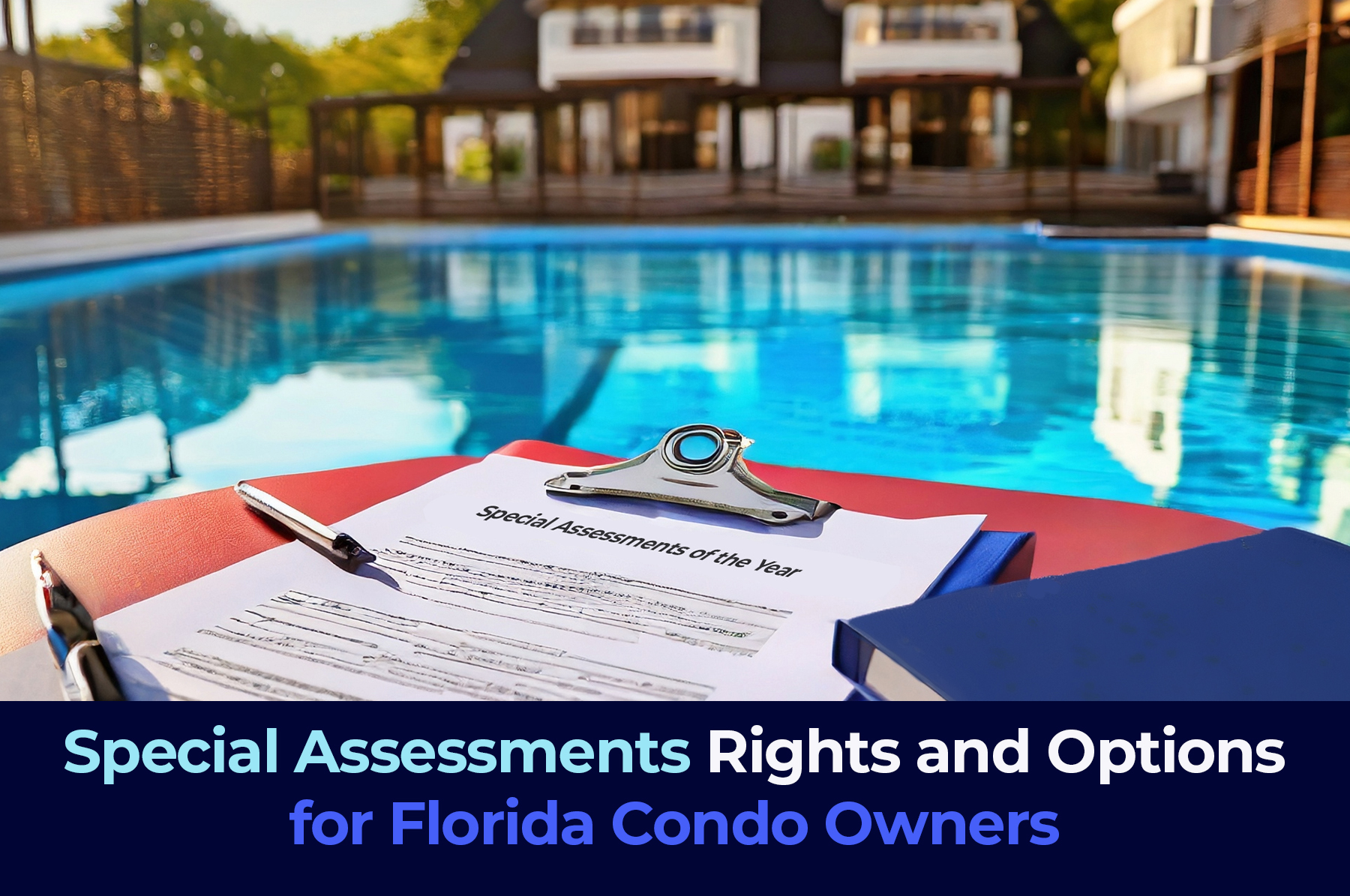
Special Assessments: Rights and Options for Florida Condo Owners
Living in a condominium comes with its share of responsibilities, and one often unexpected challenge that condo owners may face is the imposition of special assessments by their condominium associations. In the state of Florida, the term “special assessment” is specifically defined by Florida Statute 718.404(24) as “any assessment levied against a unit owner other than the assessment required by a budget adopted annually.” These assessments are additional fees charged by the condo association, separate from the regular monthly, quarterly, or annual association fees paid by condo owners.
Understanding the Scope of Special Assessments
Special assessments are not to be taken lightly, as they often cover substantial expenses, ranging from hundreds of thousands to even millions of dollars. These costs are to be divided equally or equitably among condominium owners, with a specific due date for payment. Recent legislative changes, especially in the aftermath of the Surfside condominium collapse, have led to an increase in the imposition of special assessments by condo associations throughout the state of Florida.
Special assessments make it possible to maintain the safety and livability of a condo building and are more often than not worth the inconvenience in the long run. However, special assessments can also be prohibitively expensive, so much so that it is not unheard of that condo owners are forced to sell their unit in order to pay.
Given the unique legal and financial circumstances surrounding special assessments, there are a number of options that condo owners can take when faced with the need to pay them.
Options for Dealing with Special Assessments
- Payment of the Assessment
The most straightforward option is to pay the special assessment in full by the specified due date. This ensures compliance with the condo association’s requirements and avoids any potential legal consequences.
- Requesting a Payment Plan
Condo owners facing financial constraints can explore the option of negotiating a payment plan with the association. Depending on the association and the size of the assessment being levied, a payment plan could involve spreading the assessment amount over a period of 12 months, making it more manageable for condo owners on a fixed budget.
- Financing Options
Seeking external financing is another avenue to consider. Some financial institutions offer loans specifically designed to cover special assessments, providing condo owners with the flexibility to repay the amount over time.
- Challenging the Assessment
Condo owners have the right to challenge a special assessment, especially if they believe it was levied improperly or if it does not align with the governing documents of the association and Florida statutes.
For example, legal challenges may be appropriate when a special assessment is imposed without adhering to the strict meeting announcement protocols outlined in Florida Statute. If the association fails to follow these procedures, or if the association has more stringent rules than statute and those rules have not been adhered to, then condo owners may have grounds to challenge the assessment as an invalid debt.
“[In some cases], condo owners may have grounds to challenge the assessment as an invalid debt.”
The Importance of an Attorney
Facing a special assessment can be a daunting experience for Florida condo owners. It is crucial to be aware of your rights and options and do not attempt to “go it alone.” Instead, partner with an experienced association attorney with a track record of success in handling COA and HOA cases in Florida. An experienced HOA or COA attorney can help you understand the intricacies of special assessments and keep you informed about relevant statutes. With a lawyer on their side, condo owners can navigate these challenges with greater confidence and ensure a fair resolution that aligns with their best interests.
South Florida Law
Managing a special assessment can be complex, and it is important to have an experienced HOA attorney on your side to help you to navigate the options. At South Florida Law, we have represented clients in a wide range of HOA disputes, and have represented both property owners and condo associations on matters involving special assessments. Contact us today to schedule a consultation either via our contact form or by calling (954) 900-8885.