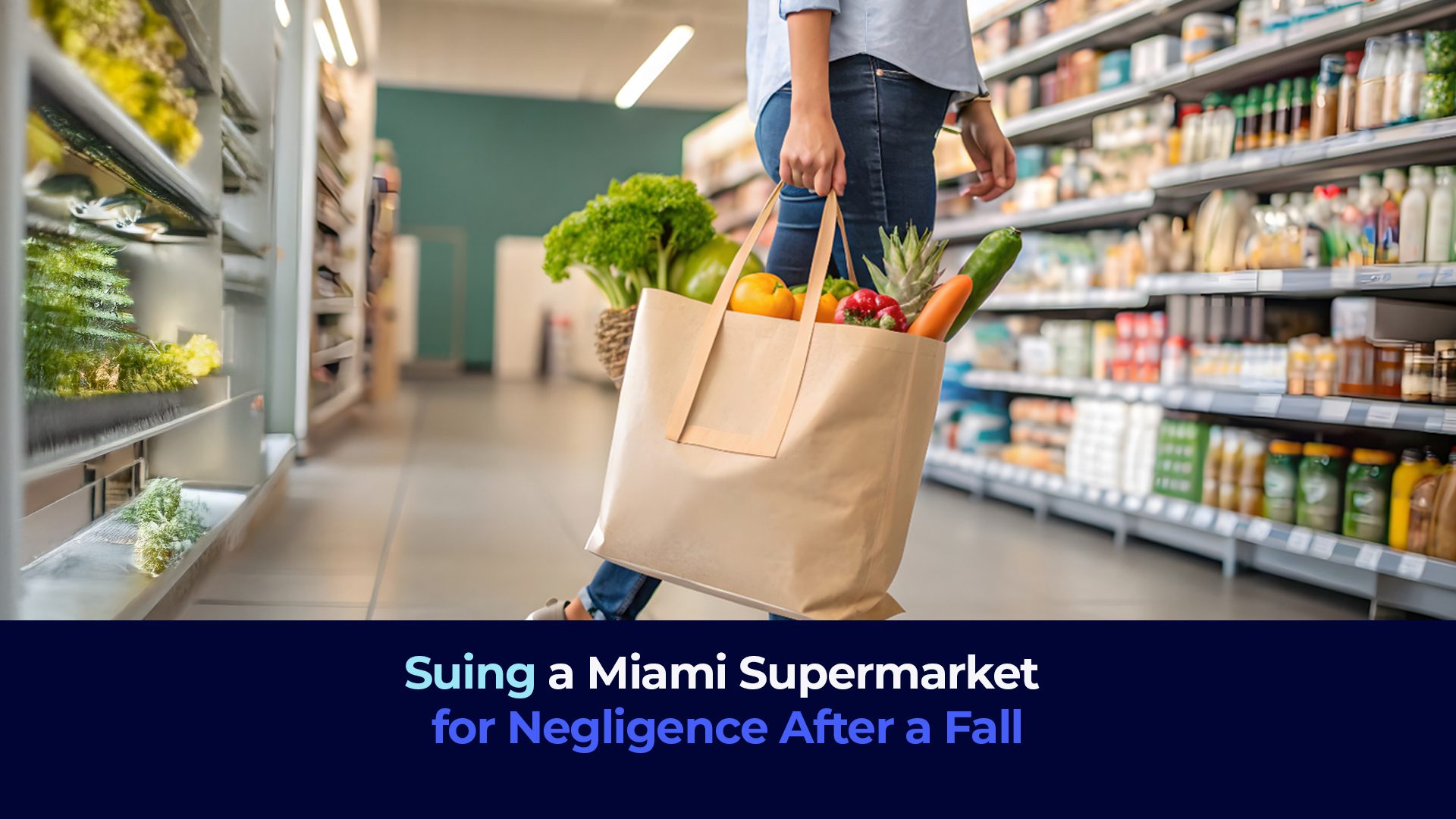
Suing a Miami Supermarket for Negligence After a Fall
Quick Read Summary (TLDR)
Suing a Miami supermarket for a fall requires proving the store was negligent, typically under Florida Statute 768.0755, which mandates showing the store had actual or constructive knowledge of the hazard. Slip and fall cases involve transitory substances like spills, while trip and fall cases involve obstacles or defects, sometimes allowing for stronger evidence of the store’s direct creation of the hazard. Injured persons must file a lawsuit within two years of the incident, as this deadline is strictly enforced. Florida’s modified comparative negligence rule means if the shopper is found more than 50% at fault for the accident, they are completely barred from recovering compensation. Due to the legal complexities and corporate defense tactics, consulting an experienced personal injury attorney is a key first step for successfully pursuing a claim.
Looking for legal representation? South Florida Law won’t charge you unless we win your case. Call us on (954) 900-8885 or reach out via our contact form.
Supermarket accidents happen more often than most people realize. A shopper walks down an aisle, slips on a wet spot or trips over merchandise left in the walkway, and suddenly finds themselves on the ground with serious injuries. When these accidents occur due to a store’s failure to maintain safe conditions, injured shoppers may have legal grounds to pursue compensation. Understanding how Florida law handles these cases is essential for anyone considering legal action against a Miami supermarket.
Florida’s Transitory Foreign Substance Law
Florida has specific laws governing slip and fall accidents in business establishments like supermarkets. Florida Statute 768.0755, commonly known as the transitory foreign substance law, establishes what an injured person must prove to hold a store liable.
Under this statute, when someone slips and falls on a transitory foreign substance in a business establishment, the injured person must prove that the business had actual or constructive knowledge of the dangerous condition and should have taken action to remedy it. A transitory foreign substance, as defined by the Florida Supreme Court in Owens v. Publix Supermarkets, refers to any liquid or solid substance, item, or object located where it does not belong.
Constructive knowledge can be proven through circumstantial evidence showing that the dangerous condition existed for such a length of time that the business should have discovered it through ordinary care, or that the condition occurred with regularity and was therefore foreseeable. This second method of proving constructive knowledge is particularly important in supermarket cases, where spills from refrigerated cases, produce sections, and customer carts happen regularly throughout the day.
Major grocery chains like Publix, Winn Dixie, and Walmart sometimes argue that customers must prove exactly how long a substance was on the floor. However, Florida law clearly allows plaintiffs to demonstrate that spills occur with regularity in supermarket environments and that stores should have systems in place (such as designated employees walking the aisles on a regular basis) to identify and clean up hazards promptly.
The Difference Between Slip and Fall and Trip and Fall Cases
It is important to keep in mind if suing a Miami supermarket that not all supermarket accidents are created equal from a legal standpoint. There is an important distinction between slip and fall accidents and trip and fall accidents that can significantly affect the strength of a plaintiff’s case.
Slip and fall accidents typically involve a liquid or slippery substance on the floor—such as spilled milk, water from a leaking freezer, or melted ice from the frozen foods section. In these cases, the transitory foreign substance law under Florida Statute 768.0755 directly applies, requiring proof of the store’s actual or constructive knowledge.
Trip and fall accidents, on the other hand, often involve obstacles or structural defects—such as boxes of merchandise left in aisles, damaged floor tiles, torn carpeting, display signs on the floor, or uneven surfaces. These cases may not always fall under the transitory foreign substance statute but can still be pursued under general premises liability principles. In some trip and fall scenarios, the hazard itself may provide stronger evidence of negligence. For example, if merchandise or a display was improperly assembled or maintained by an employee and fell into the aisle, the store’s direct involvement in creating the hazard can be more easily established.
A notable Florida case illustrates this principle. In Papakalodoukas v. Wal-Mart Stores East, LP, decided by Florida’s Fourth District Court of Appeal, a Port St. Lucie man was shopping in a Walmart store on May 15, 2011, when he stepped on a Gatorade promotional sign that had fallen from a display onto the floor. The fall tore his bicep tendon, requiring three surgeries including one that involved implanting a cadaver achilles tendon into his arm. His medical bills exceeded $200,000, and he was left with a permanent condition known as a “Popeye deformity” that prevented him from returning to his job as a beverage distribution manager.
The plaintiff argued that Walmart negligently assembled and maintained the display, causing the sign to fall. A Gatorade representative testified that if the display had been properly assembled, the sign would not have fallen. Critically, Walmart had discarded the display after the incident despite having viewed surveillance footage showing its role in causing the fall. The judge gave the jury a res ipsa loquitur instruction, meaning that jurors were allowed to infer negligence from the circumstances. The St. Lucie County jury found Walmart 90% at fault and awarded approximately $1.29 million in damages. Walmart appealed, but Florida’s Fourth District Court of Appeal affirmed the verdict. With attorney’s fees, costs, and interest, the total recovery exceeded $1.5 million.
This case demonstrates how evidence of a store’s direct role in creating a hazard, combined with the store’s failure to preserve evidence, can significantly strengthen a plaintiff’s position.
The Two-Year Statute of Limitations
Time is a critical factor in supermarket injury cases. Under Florida Statute 95.11, injured persons have only two years from the date of the accident to file a negligence lawsuit. This deadline, which was reduced from four years in March 2023, applies to all slip and fall and trip and fall cases.
Missing this deadline typically results in the court dismissing the case entirely, regardless of how serious the injuries may be or how clear the store’s negligence appears. Given the complexity of gathering evidence, obtaining surveillance footage, and building a strong case, individuals who have been injured in a supermarket accident should consult with an experienced Florida premises liability attorney as soon as possible after the incident.
Florida’s Modified Comparative Negligence Rule
Florida law also considers whether the injured person shares any responsibility for the accident. Under Florida Statute 768.81, as amended in March 2023, Florida now follows a modified comparative negligence system. This means that if an injured person is found to be more than 50% at fault for their own injuries, they are completely barred from recovering any compensation.
Supermarkets and their insurance companies regularly use this law to their advantage by arguing that the injured shopper should have seen the hazard and avoided it. This defense, known as the “open and obvious” doctrine, does not eliminate the store’s responsibility to maintain safe premises, but it can convince a jury to assign a percentage of fault to the person who fell.
For example, if a jury determines that a shopper was 30% responsible for not noticing a spill and the store was 70% responsible for failing to clean it up, the shopper’s compensation would be reduced by 30%. However, if the jury finds the shopper was 51% or more at fault, the shopper receives nothing.
“Florida law also considers whether the injured person shares any responsibility for the accident.”
Seeking Legal Guidance
Supermarket slip and fall and trip and fall cases involve complex legal standards and aggressive defense tactics from well-funded corporate defendants. Successfully proving that a store had knowledge of a dangerous condition and failed to act requires thorough investigation, proper evidence preservation, and skilled legal advocacy.
Anyone who has suffered injuries in a Miami supermarket accident should strongly consider seeking the assistance of an experienced Florida personal injury attorney. A knowledgeable lawyer can help gather critical evidence such as surveillance footage, maintenance logs, and prior incident reports, while also protecting the injured person’s rights throughout the legal process. Attempting to navigate these cases without professional legal counsel often puts injured individuals at a significant disadvantage against large retail corporations and their insurance carriers.
South Florida Law
Have you been injured in an accident and are struggling to make ends meet financially due to medical bills or an inability to work? If so, you will be pleased to hear the South Florida Law does not charge you a penny unless and until we win your case! If we agree to bring on your case, you will benefit from both the resources of a large firm and the attention to detail of a boutique firm. Getting the best of both worlds make South Florida Law unique and effective as a legal partner when you need us the most.
Personal injury statutes of limitations are real. If you’ve been injured in an accident or fall in a Miami supermarket, do not delay in contacting us for representation.
Reach out for a case review by calling (954) 900-8885 or via our contact form.