Can a Florida HOA Tow or Fine for Parking on a Public Street?
Parking disputes rank among the most common conflicts inside Florida HOAs, and they usually begin with a misunderstanding about where an association’s authority comes from. A homeowners association draws its power from a recorded declaration and from Chapter 720 of the Florida Statutes. Neither source gives it control over land it does not own. That single principle answers most questions about towing and fines on a public street.
Towing Authority Comes From the Land, Not the Covenants
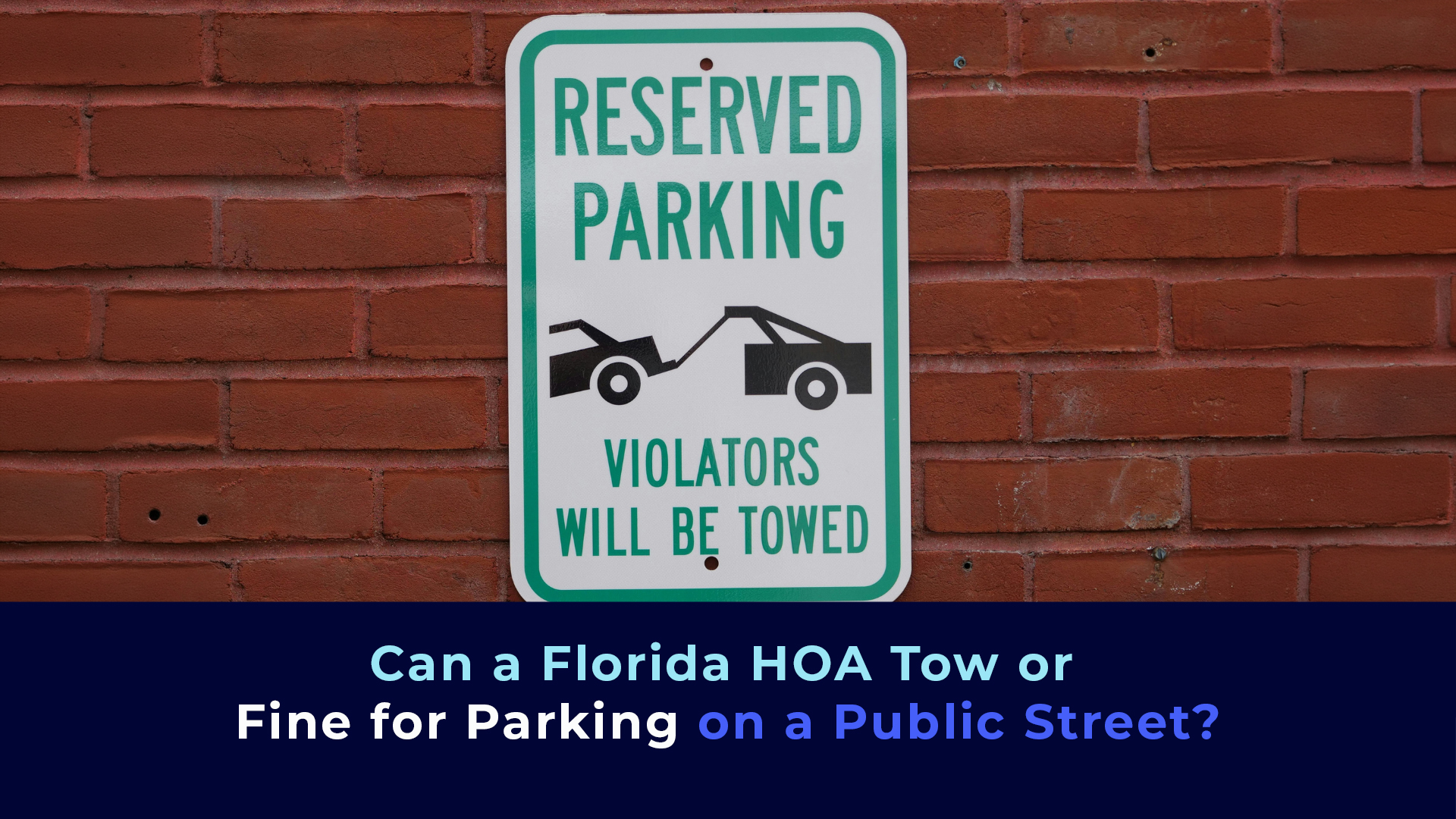
Florida Statutes Section 715.07 governs the removal of vehicles parked on private property. The statute permits a tow only with the consent of the property owner or another person in lawful control. Authority flows from control of the ground the vehicle sits on. A decal, a resident sticker, or a rule in a community handbook does not create it.
The statute also imposes strict conditions on any tow. A removed vehicle must be stored within ten miles of the pickup point in counties of 500,000 or more residents, which covers Broward, Miami-Dade, and Palm Beach. The towing company must notify local law enforcement within thirty minutes and identify the storage location, and a driver who returns before the vehicle leaves the property may reclaim it for no more than half the posted rate.
None of this reaches a street owned by a county or municipality. An association that authorizes a tow from a dedicated public right of way is directing the removal of property from land it does not control, and both it and the towing company can face liability.
Many Florida HOA Streets That Look Public Are Actually Private
The harder question is usually whether the street is public at all. The answer sits in the recorded plat. Some plats dedicate the roads and rights of way to a county or a city, which then maintains them as public streets. Others reserve the roads to the association as common area. Two subdivisions across an intersection from one another can fall on opposite sides of that line.
Appearance is a poor guide of whether a street is public or private. Gated communities often sit on private roads even where the pavement, striping, and signage look identical to the public network, and some communities without gates sit on county roads. Section 316.006 also contemplates a county abandoning roads dedicated in a recorded subdivision and conveying its interest to the association, which changes the answer going forward for that community.
Because the plat controls the outcome, it is highly recommended that boards and homeowners confirm road ownership through a title and plat review before any enforcement decision is made.
“Appearance is a poor guide of whether a street is public or private.”
An Association Fines Members, Not Drivers
Section 720.305 lets an association levy reasonable fines for violations of the declaration, the bylaws, or reasonable rules. A fine is capped at $100 per violation and $1,000 in the aggregate unless the governing documents set different figures. The owner must receive at least fourteen days notice and a hearing before an independent committee of three or more members who are not directors, officers, employees, or their close relatives. That committee can reject the fine outright, and a fine under $1,000 cannot become a lien on the parcel.
The critical detail is who owes the money. The statute reaches members, and it reaches the conduct of a member’s tenant, guest, or invitee only because the member is bound by the recorded declaration. An association cannot fine a driver who owns nothing in the community. When a delivery van from outside the neighborhood blocks a public street, no fine is available.
The 2024 Amendments Narrowed What Documents Can Restrict
House Bill 1203 amended Section 720.3075 effective July 1, 2024. Association documents may no longer preclude an owner, tenant, guest, or invitee from parking a personal vehicle, including a pickup truck, in the owner’s driveway or in any other area in which that person has a right to park under state, county, and municipal regulations. A work vehicle that is not a commercial motor vehicle under Section 320.01(25) is protected in the driveway as well.
That final phrase carries weight here. Where a public street permits parking under local rules, the statute stands as a direct obstacle to enforcing a covenant against it. Practitioners continue to debate how far the amendment reaches into declarations recorded before July 2024. That analysis turns on whether the documents adopt future statutory amendments and on whether a change counts as procedural or substantive, making it document specific and a poor candidate for self help.
Lawful Routes to Enforcement on Private Roads
Associations are not powerless. Section 316.006 lets a municipality exercise traffic jurisdiction over private roads inside its boundaries by written agreement with the party controlling them, and gives counties the same option in unincorporated areas. The board may also elect by majority vote to have state traffic laws enforced by local law enforcement on private roads the association controls. Florida Attorney General opinions have consistently concluded that absent such an agreement, traffic enforcement authority does not reach private roads.
For a genuinely public street, the remedy runs through the city or county rather than the board. Vehicles blocking a fire hydrant, crosswalk, fire lane, or accessible space can be addressed quickly by code enforcement or police.
South Florida Law
Whether an association may tow or fine over a parked car turns on facts that cannot be read off a street sign, including the plat dedication, the declaration language, and whether a traffic control agreement is in place. Confirming those items in advance costs far less than defending a wrongful tow.
South Florida Law represents homeowners and associations throughout Florida and is also a full service title agency, so the plat and dedication questions at the center of these disputes can be answered in-house at our firm. If you are facing a parking enforcement dispute, call us on (954) 900-8885 or reach out via our contact form.