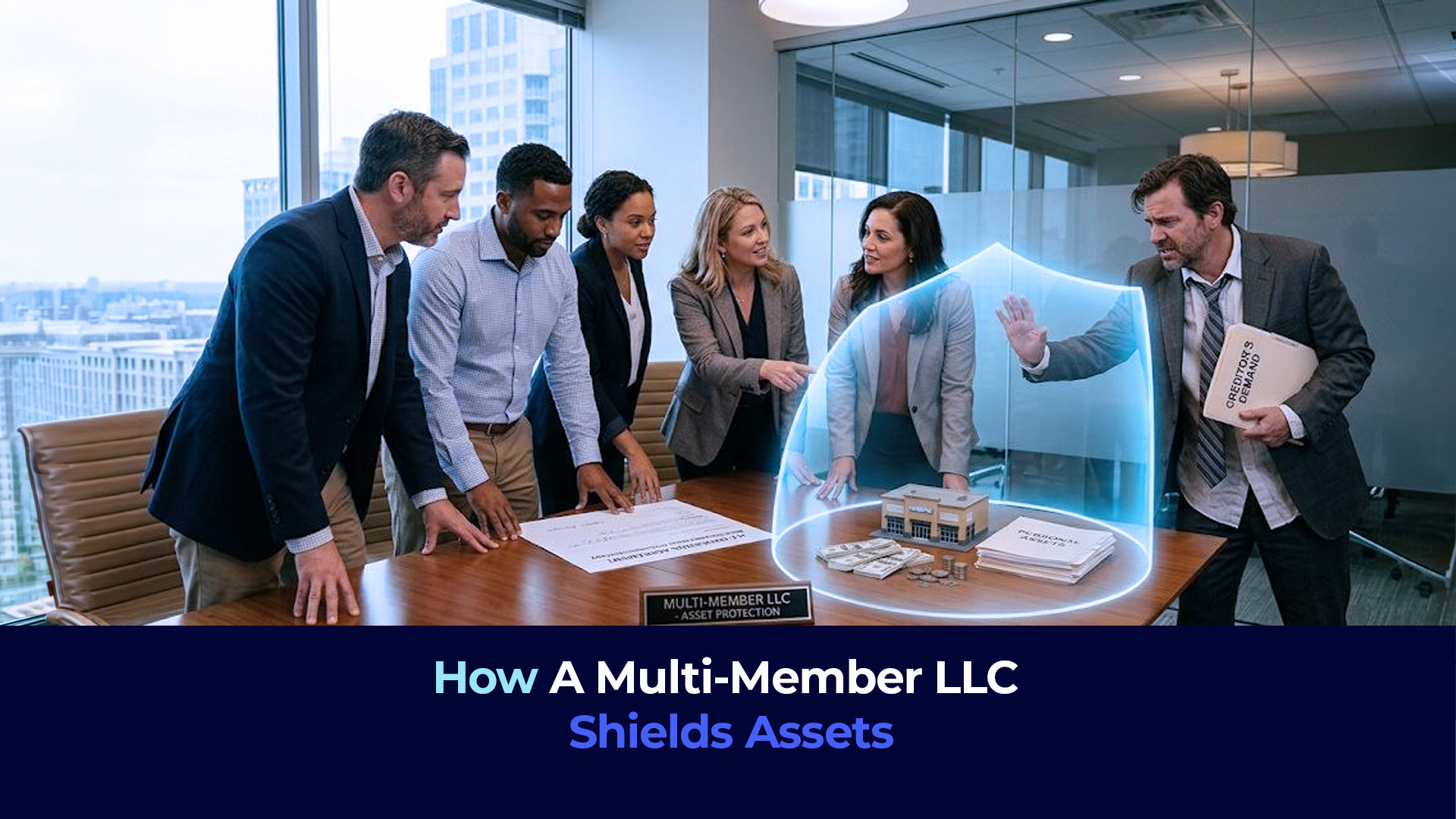
How A Multi-Member LLC Shields Assets
Quick Read Summary (TLDR)
When assets are owned personally in Florida, a creditor can quickly seize and sell them, but placing assets inside a multi-member Florida Limited Liability Company (LLC) provides a powerful shield. The multi-member LLC shield is known as charging order protection. It protects co-owners from a single member’s personal financial trouble and provides stronger asset protection than personal ownership.
If you seek charging order protection for your businesses assets, reach out to South Florida Law for a legal consultation by calling (954) 900-8885 or via our contact form.
When a person owns property directly, a creditor who wins a court judgment can often move quickly to seize and sell that property. When the same property sits inside a Florida limited liability company, the rules change. Florida law gives the owners of a multi-member LLC a powerful shield known as charging order protection. Understanding how this protection works helps explain why many business owners and investors in Florida choose to hold assets through an LLC rather than in their own names.
What a Charging Order Is
A charging order is a court remedy found in Chapter 605 of the Florida Statutes, the Florida Revised Limited Liability Company Act. The rule appears in Section 605.0503. When a creditor wins a judgment against someone who is a member of an LLC, the creditor may ask the court for a charging order against that member’s transferable interest. The charging order works as a lien. It requires the LLC to send any distribution that would have gone to the debtor to the creditor instead.
The important point is what a charging order does not allow. A charging order does not let the creditor take over the company, vote on company decisions, or force the business to sell its property. The creditor simply waits for distributions that the company may or may not ever pay.
“The creditor simply waits for distributions that the company may or may not ever pay.”
Personal Ownership Versus LLC Ownership
The difference becomes clear with an example. Suppose a creditor holds a $250,000 judgment against an individual. That person has no assets in his own name, but he owns a Florida LLC, and the LLC holds title to a parcel of real estate in Miami-Dade County. If the property were owned personally, the creditor could pursue it directly. Because the LLC owns the property, the creditor cannot simply execute on the real estate. Instead, the creditor must turn to Section 605.0503 and petition the court for a charging order against the membership interest.
This extra step is the heart of the advantage. The company’s assets stay with the company. The creditor is limited to whatever distributions the LLC chooses to make, which can be very different from having a personal asset taken and sold outright.
Why the Protection Exists
The reasoning behind charging order protection is rooted in fairness to co-owners. The remedy is designed to protect the members who do not owe the debt from being forced into a business relationship with a stranger who happens to be a creditor of one member. A creditor should not be able to disrupt a healthy company, push out the other owners, or seize property that belongs to the business simply because one member ran into personal financial trouble. By limiting the creditor to a lien on distributions, the law preserves the rights of everyone else who invested in the company.
The Exclusive Remedy for Multi-Member LLCs
For a multi-member LLC, meaning one owned by two or more members, the charging order is the sole and exclusive remedy. A judgment creditor cannot ask a court to order a foreclosure sale of the owner’s membership interest. This exclusivity is what gives multi-member LLCs their strongest protection and sets them apart from assets held in a single person’s name.
Single-member LLCs are treated differently. The owner of a single-member LLC is not immune from a foreclosure and sale of the membership interest. A court may order that sale, but only after the creditor proves that distributions under a charging order will not satisfy the judgment within a reasonable time. Because of this gap, it is highly recommended that anyone relying on an LLC for asset protection confirm whether the company truly qualifies as a multi-member entity.
Planning and Professional Guidance
Charging order protection is not automatic in every situation, and the way a company is formed and operated can affect the outcome. A poorly structured LLC may not deliver the protection an owner expects. The interplay between Florida statutes, court decisions, and the company’s own operating agreement can be complex. For these reasons, it is highly recommended that individuals work with an experienced Florida attorney rather than trying to set up or defend an asset protection structure alone.
How South Florida Law PLLC Can Help
South Florida Law is a larger-than-boutique firm that helps clients across Florida protect their assets through carefully structured business entities.
The firm’s attorneys bring substantial Florida experience in estate planning, real estate, and business law to every matter. Clients receive personalized attention rather than the one-size-fits-all treatment common at larger practices.
At the same time, South Florida Law has a depth of resources similar to a large law firm, giving our clients the best of both worlds.
If you seek charging order protection for your businesses assets, reach out to South Florida Law for a legal consultation by calling (954) 900-8885 or via our contact form.